Tuesday, August 27, 2024

El Sur


EL SUR   ***1/2

VĂ­ctor Erice
1983


IDEA:  In northern Spain in the late 1950s, a girl learns about her father's mysterious past as she comes of age.


BLURB:  The first image of El Sur, like so many of the film’s chiaroscuro-carved tableaux, is illuminated only gradually, whispering from the darkness. The source is the light of dawn filling a girl’s bedroom, but it could just as well be a projector’s lightbulb firing up, or the waxing flame that casts shadows on the wall of Plato’s cave. The stylized images conjured by Erice and Alcaine self-reflexively entwine memory and cinema, calling back to some irrecoverable past that only exists in hazy representations. For the young Estrella, those things beyond the threshold of legibility become imagos; particularly, a father who seems to possess magic, and the mysterious South from which he hails that seemingly holds the key to family unity and self-actualization. But any imaginary is built on an opposition of presence and absence, something Estrella comes to understand in the way her father fetishizes a famous movie star as a proxy for a lost love. Rifts personal and political define the narrative and poetics of El Sur, whose post-Civil War setting rumbles with generational tensions between children and their patriarchs, nations and their leaders. Estrella is older by the end of the film, but in many ways she’s as she was at the beginning: a girl at literal and metaphorical dawn, grasping toward a light that will never fully chase away the dark.

Saturday, August 17, 2024

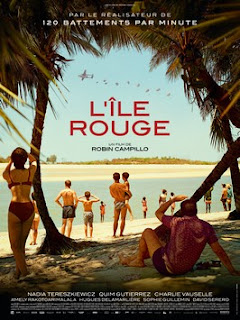
Red Island


RED ISLAND   ***

Robin Campillo
2023


IDEA:  A young French-Algerian boy grows up on a military base in Madagascar during the waning days of French occupation


BLURB:  A Bildungsroman hinges on a matter of perspective; particularly, the widening purview of a young protagonist who slowly comes to understand the complexities of the adult world into which they’re entering. With an emphasis on loss of innocence, these kinds of coming-of-age stories often take place within the context of war, injustice, or domestic unrest, all things present within the postcolonial setting of Red Island. On the titular island, eight-year-old Thomas bears witness to the erosion of national and familial stability. Like Terence Davies’s surrogate child protagonist in his semi-autobiographical The Long Day Closes, Robin Campillo’s proxy in his own auto-fiction is a queer-coded boy who peers endlessly at the straight world from a distance, glimpsing heterosexual, masculinist rituals from behind dimpled glass and through the slats of a crate. He’s also a young French-Algerian living in Madagascar, making his status one of multiple liminality. Thomas’s sphere of influence is a jumbled one, inhabited by a military father on one hand and a crime-fighting girl from a superhero comic on the other. Campillo excels in locating the disquieting juxtapositions that emerge for Thomas in this strange land, whether through a series of match cuts that link an aragonite table with aerial military views of Madagascar, a Christmas party taking place in a hangar, or a screening of Abel Gance’s Napoleon on a tropical beach at night. Similar to Claire Denis’ White Material, Campillo’s Red Island considers French colonialism in Africa from a place of lived autobiographical ambivalence, mostly through the experiences of the colonizers. But in its final act, a bold structural turn expunges the white characters and cedes the ground to the Malagasy people. It’s a necessary and elating narrative tradeoff in a film that welcomes the inevitability - and importance - of attaining a wider perspective.

Thursday, July 11, 2024

Thelma


THELMA   ***1/2

Josh Margolin
2024


IDEA:  Unable to secure the help of the authorities after she's robbed by a phone scammer, an elderly woman takes justice into her own hands and sets out to get her money back.


BLURB:  It’s not all the time you see a smart mainstream American comedy that centers an elderly person, and rarer still that she’s a 93-year-old grandma and vigilante action hero. Thelma is not only a welcome corrective to lazy, belittling, and mocking portrayals of seniors on screen, but a clever, funny, and moving portrait of late-life infirmities and triumphs alike. A gift for the nonagenarian June Squibb, her role allows her to feast on acerbic line deliveries, pathos, and even physical comedy in ways she hasn’t quite been able to before. Margolin’s script is remarkable for how slyly it toes the clichĂ©s without falling into them; while he’s playing with some of the expected tropes about older people - technological incompetence, memory issues - they are never designed to ridicule, nor are they shown to necessarily be age-specific or liabilities at all. Through Margolin’s proxy, the grandson Danny, Thelma conveys how struggles with personal independence and day-to-day life skills transcend age, and can in fact unite the unformed young with their senescent elders. The film balances such sentimental intergenerational commentary with a boisterous sense of genre fun, utilizing noir tropes in a rollicking adventure that proves one doesn’t have to take their senior years lying down (something Squibb proves by example)! Get yourself a grandchild who creates a love letter to you like this.

Saturday, June 29, 2024

Je t'aime, je t'aime


JE T'AIME, JE T'AIME   ***

Alain Resnais
1968


IDEA:  Chosen as a guinea pig for a group of scientists' experiment in time travel, a suicidal man finds himself stuck reliving moments from his troubled past relationship with his girlfriend.


BLURB:  In ways familiar from Resnais' first three feature films, Je t’aime, je t’aime attempts to translate into cinematic language the fragmentary, non-hierarchical, and elusive structure of memory. The extent to which it accomplishes this can be considered as subjective as memory itself, contingent on the degree of the spectator’s receptivity to Resnais’ willfully alienating formal trickery. Of course, the film is not channeling a typical experience of remembering but one that is literally mediated through technology. This separates Je t’aime, je t’aime from the more purely metaphorical Last Year at Marienbad or Muriel, as its spatiotemporal dislocations have a diegetic explanation rooted in the classic science-fiction device of time travel. This changes the texture and meaning of the film’s nonlinearity; as well as conveying the generalized discombobulation and rumination of a tortured psyche, it signifies an experience of time fractured by capitalist labor and modern technological innovations. Ironically, Claude’s aleatory travels answer his plea for an escape from his unchanging workaday routine, just as they further trap him in a subjectivity as intractable as time - when its social and cinematic conventions are removed - is not. Although it can come off like the stuff of airless intellectual exercise, Resnais' deformation of narrative still appears radical all these years later, when achronological storytelling is so often something to be solved rather than intuited.

Thursday, June 13, 2024

Hit Man


HIT MAN   **

Richard Linklater
2024


IDEA:  A college professor who moonlights for the police as a fake hitman falls in love with a woman who solicits his services to off her husband.


BLURB:  In its first five minutes, Hit Man erects a number of red flags that bode inauspiciously for the remaining 110: a didactic introduction of theme via a college lecture; an abundance of first-person narration; that narrator, a psychology professor, having a pair of cats named Ego and Id (would this be clever to a middle-schooler, maybe?). Unfortunately, as the film goes on, these are revealed not as bugs in Linklater and Powell’s script but features. Hit Man proceeds to double-down on its gauche tendencies, from an explication of theme that’s so on-the-nose it’s basically the nose itself to characterizations, from minor roles to the leads, that seldom ever feel convincing, whether in the context of real life or the archetypal movie-movie land Linklater is reaching for. The film does not lack for ideas - it’s clearly thinking a lot about ontology, morality, and the law - but it seems bafflingly unsure of what to do with them cinematically. Like its protean protagonist, Hit Man shifts between genres and registers, from noir to erotic drama to screwball comedy, but its interpretation of each is not only tepid, but anonymized through flat televisual lighting and camerawork and listless editing. It’s ironic that a film so explicitly about identity doesn’t really have one of its own, and that its notions of life’s caprices and the contingency of the self are filtered through such static, predictable narrative form. There’s a nifty sort of Lubitschian subversiveness to Hit Man’s final vision of conjugal social integration by way of criminality, but it arrives too late in a film that mostly lurches on its way there. 

Friday, May 31, 2024

Running on Empty


RUNNING ON EMPTY   **1/2

Sidney Lumet
1988


IDEA:  On the lam for a near-deadly act of anti-war activism they committed over a decade earlier, two parents raise their children as fugitives and grapple with their eldest son's growing independence.


BLURB:  Running on Empty is a political film that tries not to be political, and in the process, becomes more political than it ever needed to be. There are certainly a myriad of intriguing possibilities inherent in the premise of two former hippie activists who now find themselves leading a nuclear family while on the run from the law. But Naomi Foner is not interested in most of them. Instead, she uses the incident that turned them into fugitives - the protest bombing of a military facility during the Vietnam War - as merely a catalyst for a pretty typical family melodrama. Running on Empty works quite well as a family melodrama, its uniformly strong performances and frequently sharp writing deftly navigating the sorrows and ambivalences created by a child’s burgeoning independence from their parents. The sense of cyclical and universal intergenerational tension is brought powerfully home in the late scene between Annie and her estranged father, which highlights how so much of what a parent goes through with their children has been experienced in some variation by their elders, with them. Yet it’s also this scene that reinforces the film’s troubling subtext, positing liberalism as a threat to family unity. How much more interesting and productively complicated would Running on Empty be if Danny’s growth hinged on the development of political consciousness, of any ideological leaning, rather than puppy love and the bourgeois pursuit (inherited from his mother and grandmother, of course) of being a pianist at Juilliard? It would be much more interesting, and challenging. As is, Running on Empty is very much a product of Reagan-era Hollywood, slickly affecting and reactionary at heart.

Saturday, May 11, 2024

Challengers


CHALLENGERS   ***

Luca Guadagnino
2024


IDEA:  Two former best friends and tennis doubles teammates - now bitter rivals for the affection of a former tennis prodigy, who's married to one of them and used to date the other - face off in a Challenger match.


BLURB:  Tennis, lust, power, and cinematic form are inextricably bound up in Luca Guadagnino’s Challengers, an often unwieldy but clever and energetic relationship melodrama. In Justin Kuritzkes’s script, tennis serves as a metaphor for the love triangle between Tashi, Art, and Patrick, its constant volleys and shifts in advantage echoed in the trio’s push-and-pull seductions and attacks. They all take turns as both player and ball in a torrid erotic game that’s all about scoring the winning point. This sort of amour fou gamesmanship is fairly rote stuff, and there’s disappointingly little depth to the characters to make their affairs transcend the petulant devices of a group of affluent, insecure, self-absorbed children (which is, to be fair, what they are). But it’s ultimately less the story than the visual and sonic language of Challengers that teases and thrills, the ways in which Guadagnino extends the tennis metaphor into the structuring principle for his film’s very form. The back-and-forth gameplay of tennis inflects everything from the narrative’s ping-ponging jumps in time to the swish-panning camera movements to Trent Reznor and Atticus Ross’s score, which sounds like a techno translation of a tennis ball caught in an endless rally. For better and worse, Challengers fully embraces the repetition that’s an essential characteristic of the game; it has no wariness about how often it rehashes the competition between its protagonists, nor is it timid in its copious use of slow motion to protract a moment or linger sensuously on a face (or chest). Yet these formal expressions viscerally serve a thematic purpose, locating in repetition, frustration, fatigue, and calisthenic pleasure the ingredients of tennis as much as desire.