Friday, December 22, 2023

The Killer


THE KILLER   ***1/2

David Fincher
2023


IDEA:  Following a botched hit, a contract killer attempts to clean up his mess by targeting the higher-ups who are out for him.


BLURB:  At first, Michael Fassbender’s titular Killer might seem like a disciplined and honorable - even cool - ascetic-type master warrior, in the vein of Jef Costello in Le Samouraï or the Lone Man in The Limits of Control. But within minutes of listening to his continuously running internal monologue, one easily grasps that this guy is really a narcissistic, self-aggrandizing douchebag. He has more in common with such past Fincher protagonists as Fight Club’s Narrator or The Social Network’s Mark Zuckerberg, deeply insecure white men who take laborious pains to convince themselves of their worth in an increasingly estranging, atomized techno-capitalist culture. The Killer is particularly and mordantly attuned to how this figure manifests today, when the propagation of militant far-right ideology on social media platforms has deluded a contingent of cisgender white men into thinking they’re the ones actually being attacked, and the answer is to take up arms and “fuck your feelings.” This resonates with the Killer’s mantra to “forbid empathy,” as “empathy is weakness” and “weakness is vulnerability.” As he drones on about his noble precepts and work ethic - things he then consistently undermines in his actions - The Killer reveals itself as a sharp, blackly funny satire of a kind of digital-age self-absorbed derangement, abetted by a dehumanizing global capitalist order that reduces human interaction to the logic of commerce. DP Erik Messerschmidt renders this world in inky cobalt-black cut by queasy chartreuse and orange, panes of glass and the eerie glow of electronic locks. Despite the darkness, there could be absolution yet for the Killer, a fan of the Smiths who might just have to admit to himself that his IDGAF attitude is barely suppressing the fact that he does give a fuck.

Wednesday, December 20, 2023

Fallen Leaves


FALLEN LEAVES   ***

Aki Kaurismäki
2023


IDEA:  Two blue-collar laborers find a budding connection with each other amid the doldrums of their lives.


BLURB:  Cut from the same cloth as Bresson, Jarmusch, and Roy Andersson, Aki Kaurismäki operates in a mode of deadpan, laconic anti-naturalism that generates its own all-encompassing affective universe. It’s a drab, mostly unforgiving world through which the characters lumber like zombies, numbed to the routines of modern wage labor and well-ensconced in the warm, dark arms of disillusionment. Kaurismäki makes you feel the weight of the world on Ansa and Holappa, setting their lethargic movements in shadowy, noir-ish interiors and on frigid gray streets that seem equally suffocating. Yet Fallen Leaves never lapses into miserabilism. Kaurismäki’s characters may be down-on-their-luck working drudges living in spartan quarters with a single set of dinnerware, but they also have brute stoicism, which Kaurismäki and his actors carefully and unsentimentally wield in the form of droll impassivity. Ansa and Holappa also have empathy, a buried light that Fallen Leaves gently teases out from its pallid Helsinki cityscape. Their bumpy but eventually redemptive courtship has the sweet simplicity of a silent movie, particularly a Chaplin, who is not-incidentally named in the film’s pithy punchline. Popular culture frames Ansa and Holappa’s romance throughout, from classic movie posters to the diegetic songs that seem to perfectly narrate their emotions. They simultaneously serve as escapes and grounding mechanisms, ways of finding oneself in - and back to - a world that often feels so distant.

Sunday, December 10, 2023

May December


MAY DECEMBER   ***1/2

Todd Haynes
2023


IDEA:  Over two decades after a woman began a scandal-provoking relationship with a 13-year-old boy, to whom she's now married with children, an actress comes to town to visit her in preparation to play her in a movie.


BLURB:  Mirrors appear frequently throughout May December, but they’re not exactly visible during their most significant occurrences. Echoing the haunting final shot of his 1995 film Safe, Haynes turns the screen itself into the mirror as his actresses peer out at us from the other side. Lacking the ego-defining configuration of mirror/subject in the same image, our perception is subtly destabilized: are we seeing the real thing or the reflection? It’s a question entirely emblematic of May December, an impeccably slippery psychological drama that’s continuously interrogating ambiguous relationships between truth and fiction, authenticity and performance, what people say and do and what they believe. The particular quotient of any of these things is never clarified in Samy Burch’s script nor through the masterfully layered performances of Moore and Portman, who create a shifting dynamic of power that leaves us wondering who’s really playing whom. With its scandalous subject matter, coiled eroticism, and juicy games of predation and subterfuge, May December is always on the verge of breaking out into Grand Guignol luridness, but Haynes denies the impulse. Pointedly resisting the exploitative sensationalism under his microscope, the director films in muted, washed-out taupes and grays while cleverly avoiding sordid recreations of the primal incident. The soft, glassy flatness of the images and the crashing score may suggest a true crime television serial, but Haynes isn’t interested in uncovering a crime or explaining psychology. As in the vacuous suburban domesticity of Safe, the shivery strength of May December is how it agonizingly chips away at seemingly stable social roles, narratives, and identities that are revealed to be anything but.

Sunday, December 3, 2023

Menus-Plaisirs - Les Troisgros


MENUS-PLAISIRS - LES TROISGROS   ***1/2

Frederick Wiseman
2023


IDEA:  A look inside the Michelin three-starred Troisgros restaurant in Ouches, France and its culinary legacy.


BLURB:  Between the haute cuisine of Menus-Plaisirs - Les Troisgros and Tran Anh Hung’s The Taste of Things, 2023 is quite the year for the French foodie film. Of course, being a Frederick Wiseman movie, Menus-Plaisirs has a scope quite a bit wider than the domestic ambit of Tran’s 19th-century lover-gourmets. In his signature fashion, the filmmaker studies a panoply of aspects of his central subject, the Troisgros restaurant, from its meal preparations and clientele to the local farms and cheesemakers that supply its ingredients. The magic of a Wiseman documentary, in addition to the hypnotic rhythms they generate from quotidian activities, is in the serendipitous accrual of detail and meaning across typically extended durations, so that what happens in one scene retroactively attains new significance during later ones. Here, an in-depth description of how sulfites are used to inhibit oxidization in wine forms a dialogue with discussions about various other human interventions in food cultivation, from agriculture to cheese ripening, eventually adding up to a broader existential picture of ecological balance, contingency, and the flux of trends. Like all of the institutions he studies, Wiseman finds a microcosm of society - if not life itself - in the bureaucracies, systems of labor, creative processes, and social rituals of Troisgros. He also finds a mirror of his own practice, with the aesthetic and culinary exactitude of the chefs echoing his patient and studiously watchful style. Movingly, Wiseman seems to invite especial parallels with the gregarious, august Michel Troisgros, who passionately carries on a decades-long tradition as time takes its inexorable course, and who extols the power of learning through nothing so simple as our attention and observation.

Wednesday, November 22, 2023

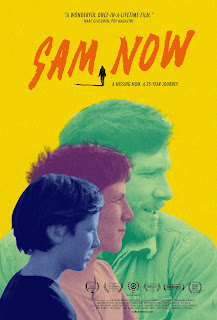
Sam Now


SAM NOW   ***

Reed Harkness
2022


IDEA:  A decades-spanning portrait of Sam Harkness, who embarked on a road trip with his half-brother to find the mother who abruptly left him when he was a teen.


BLURB:  There’s a whole category of documentaries that self-consciously turn the filmmaking process into a kind of therapy, either for the maker or the subject(s) in front of the camera. Many of these, such as Stories We Tell, Minding the Gap, or Dick Johnson is Dead, turn to family matters, using archival footage and staged scenarios to process deeply rooted traumas that would otherwise be difficult to confront. Reed Harkness’s Sam Now both fits and complicates this idiom. On the most explicit level, the film is an attempt by Harkness to give closure to his half-brother Sam, to help him heal from the wounds left from being abandoned by his mother, Jois, when he was 14. To do this, he continues a lifelong project of filming his brother - usually in playful 8 mm home movies - as a documented West Coast road trip in search of the absent mother. During the trip, Reed has Sam adopt an alter ego named the Blue Panther, in effect creating a fiction through which to stage a fantasy of reconciliation. But the brothers don’t need to create a fantasy, as fairly early into their journey they find the person they’ve been looking for. Most of Sam Now unfolds after the reunion, a putative catharsis that never quite comes. The film is wise about facing the reality that the people Sam, his mother, and his other family members used to be are no longer who they are now, and maybe weren’t even who they thought they were then. Harkness quickly realizes that “healing” may not even be possible, and that the best anyone can do is understand the social factors, often originating before our lifetimes, that influence the choices we make. Although Reed’s own perspective on his mother is under-explored - perhaps his filmmaking practice, and his focus on his brother, is his way of sublimating his feelings - Sam Now is impressively lucid and empathic in detailing the cycles of intergenerational trauma.

Sunday, November 5, 2023

Killers of the Flower Moon


KILLERS OF THE FLOWER MOON   ***

Martin Scorsese
2023


IDEA:  In 1920s Osage County, Oklahoma, white settlers carry out a complex scheme to kill the community's Native American inhabitants and inherit their oil fortunes.


BLURB:  Sometimes, even when he’s not making a mafia movie, Scorsese ends up making a mafia movie. In Killers of the Flower Moon, the system of power through which William Hale exerts his control over Osage County has the unmistakable structure and logic of an organized crime syndicate, with Hale as the don enlisting various lackeys to do his dirty bidding. A self-proclaimed King in an opulent farmhouse separated from town, he operates through coercion, blackmail, and a sense of absolute impunity owing to his position as a powerful white man. Scorsese devotes the bulk of Killers of the Flower Moon to his machinations, which are carried out in systemic complicity by a host of white male accomplices at all levels of society, from his doltish nephew to a pair of physicians. The violence perpetrated against the Osage, through the hegemony of colonialism as well as in specific targeted murders (often shown, in a sign of the oppressors’ brazenness, in broad daylight), is depicted by Scorsese with a matter-of-fact bluntness that leaves no room for ambiguity about the institutional evil at play. While his indictment is forceful and damning, Scorsese’s focus on the figures of white supremacy presents a problem of perspective. He is so compelled by the slimy Hale and Burkhart that his Native American characters feel close to peripheral; even Lily Gladstone’s Mollie, the putative heart of the story, is shunted aside for much of the film as she withers away on her sickbed, seen mostly from the point of view of her more psychologically-legible husband. Were Scorsese and his co-screenwriter Eric Roth not comfortable narrating through the perspective of a Native woman? Even if so, could they not have given more of the film’s epic 206-minute runtime to the Osage themselves, to their thoughts and inner-lives, their experiences beyond atrocity? Instead of being that expansive historical-cultural portrait, Killers of the Flower Moon mostly hews to the Scorsese familiar of patriarchal violence, transposed to a context where it effectively and valuably, if staidly, highlights a timeless American fascism. 

Wednesday, October 18, 2023

Evil Does Not Exist

Part of my coverage of the 59th Chicago International Film Festival.


EVIL DOES NOT EXIST   ***

Ryusuke Hamaguchi
2023


IDEA:  A rural village in Japan is thrown out of order when a company arrives with plans to build a tourist site there.


BLURB:  It starts calmly, almost eerily calmly, with the camera gliding through a wintry forest, peering up at bare tree branches passing overhead. A curious young girl enters the scene, then a man methodically chopping wood and bottling water from a stream. For some time, we continue to be lulled into the languid rhythms of this bucolic milieu, sensitized to its scenery and the rituals of its inhabitants through long tracking shots that allow us to fully sink into the images. Through this hushed, laconic style, Hamaguchi engenders the kind of placid atmosphere that feels as though it could be shattered at any moment by the first sign of disruption. So when spokespeople arrive in the small village to promote a “glamping” site their client plans to construct there, it seems fairly obvious who the disruptors will be, and what kind of harm they’ll be bringing to the environment and its people. But Hamaguchi is not so schematic; he wants to challenge our biases and sympathies. After a protracted town hall sequence that more-or-less paints a dichotomy between noble villagers and uncaring corporate stooges, Evil Does Not Exist shifts its point-of-view and slyly destabilizes the hierarchy, its target eventually growing as nebulous as the mist that descends upon the woods in the film’s single, shocking act of violence. Is Hamaguchi’s title ironic, and evil is in fact everywhere? Being the humanist that he is, it’s more likely that he’s sincere, and that for him the world is less filled with evil than it is with opportunistic economic systems that subsume us all. In the quasi-magical realist denouement of Evil Does Not Exist, nature may fight back, but the damage has been done.