Wednesday, November 22, 2023

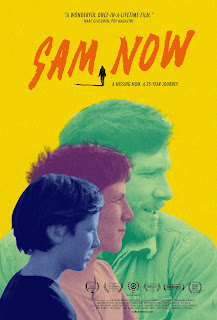
Sam Now


SAM NOW   ***

Reed Harkness
2022


IDEA:  A decades-spanning portrait of Sam Harkness, who embarked on a road trip with his half-brother to find the mother who abruptly left him when he was a teen.


BLURB:  There’s a whole category of documentaries that self-consciously turn the filmmaking process into a kind of therapy, either for the maker or the subject(s) in front of the camera. Many of these, such as Stories We Tell, Minding the Gap, or Dick Johnson is Dead, turn to family matters, using archival footage and staged scenarios to process deeply rooted traumas that would otherwise be difficult to confront. Reed Harkness’s Sam Now both fits and complicates this idiom. On the most explicit level, the film is an attempt by Harkness to give closure to his half-brother Sam, to help him heal from the wounds left from being abandoned by his mother, Jois, when he was 14. To do this, he continues a lifelong project of filming his brother - usually in playful 8 mm home movies - as a documented West Coast road trip in search of the absent mother. During the trip, Reed has Sam adopt an alter ego named the Blue Panther, in effect creating a fiction through which to stage a fantasy of reconciliation. But the brothers don’t need to create a fantasy, as fairly early into their journey they find the person they’ve been looking for. Most of Sam Now unfolds after the reunion, a putative catharsis that never quite comes. The film is wise about facing the reality that the people Sam, his mother, and his other family members used to be are no longer who they are now, and maybe weren’t even who they thought they were then. Harkness quickly realizes that “healing” may not even be possible, and that the best anyone can do is understand the social factors, often originating before our lifetimes, that influence the choices we make. Although Reed’s own perspective on his mother is under-explored - perhaps his filmmaking practice, and his focus on his brother, is his way of sublimating his feelings - Sam Now is impressively lucid and empathic in detailing the cycles of intergenerational trauma.

Sunday, November 5, 2023

Killers of the Flower Moon


KILLERS OF THE FLOWER MOON   ***

Martin Scorsese
2023


IDEA:  In 1920s Osage County, Oklahoma, white settlers carry out a complex scheme to kill the community's Native American inhabitants and inherit their oil fortunes.


BLURB:  Sometimes, even when he’s not making a mafia movie, Scorsese ends up making a mafia movie. In Killers of the Flower Moon, the system of power through which William Hale exerts his control over Osage County has the unmistakable structure and logic of an organized crime syndicate, with Hale as the don enlisting various lackeys to do his dirty bidding. A self-proclaimed King in an opulent farmhouse separated from town, he operates through coercion, blackmail, and a sense of absolute impunity owing to his position as a powerful white man. Scorsese devotes the bulk of Killers of the Flower Moon to his machinations, which are carried out in systemic complicity by a host of white male accomplices at all levels of society, from his doltish nephew to a pair of physicians. The violence perpetrated against the Osage, through the hegemony of colonialism as well as in specific targeted murders (often shown, in a sign of the oppressors’ brazenness, in broad daylight), is depicted by Scorsese with a matter-of-fact bluntness that leaves no room for ambiguity about the institutional evil at play. While his indictment is forceful and damning, Scorsese’s focus on the figures of white supremacy presents a problem of perspective. He is so compelled by the slimy Hale and Burkhart that his Native American characters feel close to peripheral; even Lily Gladstone’s Mollie, the putative heart of the story, is shunted aside for much of the film as she withers away on her sickbed, seen mostly from the point of view of her more psychologically-legible husband. Were Scorsese and his co-screenwriter Eric Roth not comfortable narrating through the perspective of a Native woman? Even if so, could they not have given more of the film’s epic 206-minute runtime to the Osage themselves, to their thoughts and inner-lives, their experiences beyond atrocity? Instead of being that expansive historical-cultural portrait, Killers of the Flower Moon mostly hews to the Scorsese familiar of patriarchal violence, transposed to a context where it effectively and valuably, if staidly, highlights a timeless American fascism. 

Wednesday, October 18, 2023

Evil Does Not Exist

Part of my coverage of the 59th Chicago International Film Festival.


EVIL DOES NOT EXIST   ***

Ryusuke Hamaguchi
2023


IDEA:  A rural village in Japan is thrown out of order when a company arrives with plans to build a tourist site there.


BLURB:  It starts calmly, almost eerily calmly, with the camera gliding through a wintry forest, peering up at bare tree branches passing overhead. A curious young girl enters the scene, then a man methodically chopping wood and bottling water from a stream. For some time, we continue to be lulled into the languid rhythms of this bucolic milieu, sensitized to its scenery and the rituals of its inhabitants through long tracking shots that allow us to fully sink into the images. Through this hushed, laconic style, Hamaguchi engenders the kind of placid atmosphere that feels as though it could be shattered at any moment by the first sign of disruption. So when spokespeople arrive in the small village to promote a “glamping” site their client plans to construct there, it seems fairly obvious who the disruptors will be, and what kind of harm they’ll be bringing to the environment and its people. But Hamaguchi is not so schematic; he wants to challenge our biases and sympathies. After a protracted town hall sequence that more-or-less paints a dichotomy between noble villagers and uncaring corporate stooges, Evil Does Not Exist shifts its point-of-view and slyly destabilizes the hierarchy, its target eventually growing as nebulous as the mist that descends upon the woods in the film’s single, shocking act of violence. Is Hamaguchi’s title ironic, and evil is in fact everywhere? Being the humanist that he is, it’s more likely that he’s sincere, and that for him the world is less filled with evil than it is with opportunistic economic systems that subsume us all. In the quasi-magical realist denouement of Evil Does Not Exist, nature may fight back, but the damage has been done.

Monday, October 16, 2023

Do Not Expect Too Much from the End of the World

Part of my coverage of the 59th Chicago International Film Festival.


DO NOT EXPECT TOO MUCH FROM THE END OF THE WORLD   ***1/2

Radu Jude
2023


IDEA:  Working for a media agency that's been hired to film an occupational safety PSA for a multinational conglomerate, production assistant Angela drives around Bucharest gathering interviews with injured employees of the corporation.


BLURB:  With Bad Luck Banging or Loony Porn and now Do Not Expect Too Much from the End of the World, Radu Jude has cemented himself as a truly world-class Marxist auteur, as confrontational and formally audacious as Godard or Makavejev. Once again, he mercilessly trains his crosshairs on global capitalism and its draconian systems of exploitation, moving seamlessly between fiction, documentary, and essay with a vernacular so bracingly of-the-moment it puts to shame most movies that purport to tap the zeitgeist. Jude is particularly concerned with late-stage capitalist labor economies, and through the travails of his protagonist, the harried but brusquely no-nonsense Angela, he pieces together a darkly absurdist sociopolitical jeremiad about people at the mercy of a corporate hegemony that scarcely hides its complete lack of principles. The potency of Jude’s critique has much to do with his keen understanding of both world and film history, of how images serve as invaluable and increasingly manipulable ideological tools. Do Not Expect… is literally structured as a dialogue with the past, intercutting its own story with scenes from the 1981 Romanian film Angela Moves On; in this “conversation,” as in the numerous intertextual quotes, allusions, and parables that make up Jude’s densely written script, the film exposes the structures of power that proliferate across time and location, undergirding our lives in newer forms but remaining as barbaric as ever. It’s the callous greed of a corporation that wants to rebury the bodies in an adjacent cemetery taking up its space; the neglect of a government whose lax construction laws are reflected in the 600 crosses lining a 250 km stretch of road, filmed by Jude in a solemn, totally silent montage that halts the narrative for several minutes; and in the multinational conglomerate that forces its liability in workplace accidents onto its desperate, overworked and underpaid employees. If Jude tells us to not expect too much from the end of the world, it’s probably because it won’t look much different from the dystopia we’re already living.

Sunday, October 15, 2023

The Boy and the Heron

Part of my coverage of the 59th Chicago International Film Festival.


THE BOY AND THE HERON   ***

Hayao Miyazaki
2023


IDEA:  Having lost his mother in a firebombing in Tokyo during World War II, Mahito moves to the countryside with his father and stepmother, where he stumbles upon a fantastical parallel reality.


BLURB:  In Miyazaki’s fables of childhood, as in so many stories about youth, the protagonist ventures into a magical alternate reality that allows them to process the tumultuous events in their life. So it is in The Boy and the Heron, a bildungsroman in the vein of Spirited Away that finds a boy confronting his wartime trauma, filial angst, and self-limitations in a fantasy underworld populated by voracious, mutated birdlife and the alter-egos of both the dead and living. Miyazaki realizes this oneiric realm with some of the most astonishingly vivid and nuanced animation of his career, reveling in precise modulations of color, texture, and movement within a landscape that defies the laws of physics in unexpected and often hilarious ways. Whether it’s something as mundane as the way a drop of water rolls down Mahito’s chin as he takes a drink of water from a mug, or as spectacularly weird as an army of steroidal parakeets bustling in a dining hall, or as primally frightening as a city engulfed in flames, the animation has a supple expressiveness that is ravishing to behold. It’s somewhat frustrating, then, that the world it articulates feels rather haphazard, muddy in its rules and parameters and oddly underdeveloped considering Miyazaki’s prodigious imagination. How does society operate here? If it’s a land of unborn souls as well as a haven for endangered animals, why are there younger versions of people who have already lived, and why are there so few kinds of animals? The fuzzy nature of this reality blunts the emotional through-line of The Boy and the Heron, which lacks the storytelling elegance and thematic focus of Spirited Away. Still, it’s a gorgeous-looking and -sounding journey, and another feather in the cap of a master artist who hardly needs to prove his genius.

Friday, October 13, 2023

All of Us Strangers

Part of my coverage of the 59th Chicago International Film Festival.


ALL OF US STRANGERS   ***

Andrew Haigh
2023


IDEA:  Living a solitary existence in a nearly empty apartment complex in London, a gay screenwriter journeys back home to the suburbs and finds his parents, who died many decades earlier, still alive as their past selves.


BLURB:  The adage “you can never go home again” is given a heartrending twist in Andrew Haigh’s latest intimate study in loneliness, otherness, and family trauma. Returning to the LGBTQ themes of his breakout feature, Weekend, the film dramatizes a complex melancholy particular to a gay man of a certain age: namely, the sense of lost time and possibility, of experiences that never happened because a society averse to your identity got in the way. These lost experiences - coming out to family, being in love, being loved - are figured in All of Us Strangers as spectral things that can only be conjured through storytelling imagination. It’s through his autofictional screenwriting, Haigh suggests, that Adam (a superb Andrew Scott) is able to commune with his deceased parents, to fill them in on what’s happened since their tragic deaths and retcon the things that maybe should have happened when they were still alive. Haigh goes directly for the tear ducts in the conversations between Adam and his parents, preserved in his memory as their 30-something selves, basking in a golden glow; the scenario flirts with the maudlin, especially in the film’s later, weepier stages, but seeing it acted out in such affectionate detail is undeniably cathartic. In its mournful depiction of a gay man’s limbo between a traumatic, uprooted past and a seeming void of a future, All of Us Strangers sometimes recalls the work of the late great Terence Davies, down to the use of musical motifs, dreamlike dissolves, and visual reflections. But it is ultimately more hopeful than that, thanks in part to Paul Mescal’s Harry, who shows Adam a way to survive through love and kinship. Haigh can’t exactly avoid the corniness of that notion, but he leans into it with disarming earnestness, unabashedly blasting Frankie Goes to Hollywood’s “The Power of Love” like a clarion call and anthem for the dejected.

Wednesday, October 11, 2023

Poor Things

Part of my coverage of the 59th Chicago International Film Festival.


POOR THINGS   ***

Yorgos Lanthimos
2023


IDEA:  Reanimated by a mad scientist in Victorian England, a woman with the brain of an infant sets out into the world in search of wisdom and independence. 


BLURB:  If Greta Gerwig’s Barbie had 100% more sex, nudity, profanity, and brain transplants, it would look something like Yorgos Lanthimos’s Poor Things. As in Gerwig’s contemporaneous phenom, the film charts a naive, sheltered woman’s universe-crossing odyssey toward self-actualization and independence in an oppressively patriarchal society. Emma Stone’s Bella Baxter may not be plastic, but she’s very much the creation of someone else, a (literal) girl in a woman’s body who’s slowly discovering her autonomy. And she’s joined by a Ken of her own in the form of the vain and irascible man-child Duncan Wedderburn, played by Mark Ruffalo with an over-the-top antic bravado to rival Ryan Gosling’s performance. There are even opulent, candy-colored sets and fake backgrounds that look like they emerged from a vat of acid on an old MGM lot. Set against the restrictive mores of the Victorian era - albeit an era transformed by Lanthimos and his production designers into a vagina-patterned, rainbow-hued steampunk phantasmagoria - the film devotes much of its time to exploiting the comedic potentials in the clash between its protagonist’s lack of inhibition and the “polite” society she blithely shows up. These scenes are often very funny, sharply acted and cut, but they’re also pretty obvious and tautological; the same can be said for Ruffalo’s caterwauling refrain upon the latest cold shoulder from his object of desire. If there’s a critical difference between Barbie and Poor Things, it has to do with the genders of their makers. Both films center on a woman’s coming-of-age, but Lanthimos’s, which is notably adapted by a man from a novel by a man, seems more interested in inventorying the toxic masculinities of its rogue’s gallery of men. There is something more than a tad prurient in its continual focus on Stone’s nude body, and in the primacy it assigns to sex as a means of personal liberation. While its gaze may prove disappointingly conventional, Poor Things swims in so much aesthetic imagination and deliciously sardonic language that it’s an experience worth indulging.