Sunday, November 21, 2021

Top 10 - 2020


No, you're not going crazy: we're just over a month away from 2022 and I'm only now getting around to posting my top ten list for 2020. The reasons for this rather extreme tardiness mostly have to do with the fact that 2020 was a strange and tumultuous year; its many intersecting disruptions hardly need to be recapitulated. That perhaps the biggest personal impact the pandemic had on my life was how it threw my moviegoing out of whack reveals that I don't really have much to complain about. Still, with theaters shut down and so many films locked behind the paywalls of the seemingly hundreds of streaming services in existence, it was a weird and unsettling time to be a cinephile. I saw fewer new movies than in any other year of my adult life, and was playing catch-up long into 2021. Some notable titles, such as American Utopia and Wolfwalkers, I still have not been able to see. 

After all the real-world turbulence and my own temporizing, I decided to just make the damn list already (I am a completist, after all; I couldn't let a lacuna in my archives perpetuate the idea that 2020 was just one big void in time). Even more than usual, this feels like a provisional ranking, culled as it is from a relatively small pool of films to which I really responded. Notably, it includes more documentaries than I've ever had on any previous top ten, with non-fiction films taking up exactly 50% of the list. Chalk it up to a year in which facing ugly realities proved to be unavoidable.


My top ten, comprised of stills and a few words, is after the jump...


Tuesday, November 16, 2021

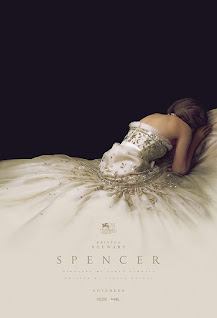
Spencer


SPENCER   ***

Pablo Larraín
2021


IDEA:  During her visit to Sandringham Estate on Christmas weekend in 1991, Lady Diana find herself uneasily navigating tensions with her cheating husband and his family.


BLURB:  As conceived by Steven Knight and Pablo Larraín, Spencer is something of a ghost story; it presents an ossified, fog-shrouded Sandringham Estate symbolically haunted by the memory of one of the modern Crown’s most publicized victims. Here, the People’s Princess is not radiant celebrity, but a despondent girl trembling in designer clothes and slumped on the bathroom floor retching over a toilet, a body and mind visibly depleted by the soul-sucking institution of the royal family and its stringently fusty codes of conduct. Kristen Stewart takes on the often jarring nature of this unromantic depiction by situating her performance somewhere in the gap between reality and the collective imagination; never fully disappearing into the role through typical biopic mimesis, she instead stretches and unsettles the iconicity of Diana to the point where we question how much about her we really know, or have ever been able to. The approach doesn’t so much illuminate her legacy as compound its mystique - this is a self-described “fable” after all. If Spencer is questionable, then, in its strategy of knowingly retrospective (and revisionist) portraiture, it’s more straightforwardly effective as a harrowing, expressionistic account of the psychological state of someone being slowly suffocated by social expectation and public scrutiny. The strings and organs of Jonny Greenwood’s score constrict around Claire Mathon’s gorgeously fragile images like the pearls around Diana’s neck; there’s room to roam but nowhere to escape the vice-like grip of demanding eyes. Crucially, Spencer lets its heroine, and us, come up for air in the denouement, giving Diana a valediction transcending her tragic fate.

Friday, November 12, 2021

Dune: Part One


DUNE: PART ONE   ***1/2

Denis Villeneuve
2021


IDEA:  Thousands of years in the future, war is waged over the desert planet Arrakis. Caught up in the conflict is the heir to a galactic noble house that's attempting to ally itself with the planet's native people.


BLURB:  The most arresting thing about Denis Villeneuve’s Dune: Part One is its formidable sense of physical magnitude. Understanding that a work of epic fiction calls for an enormous canvas, the director and his superior crafts team have realized a vision with a focus toward the sublime. For 150 minutes, they treat us to an opulent parade of images that play on the parallactic juxtaposition of scales, resulting in breathtaking views of elephantine contrasts: tiny figures dwarfed by brutalist architecture; soldiers coalescing into sprawling phalanxes; massive machinery devoured (literally) by even more supersized sandworms. Villeneuve and crew orchestrate a number of sweeping action set pieces that recall a largely lost form of epic big-budget filmmaking, creating and maintaining scale through an elegant, always legible rendering of spatial relationships. Has sand been so palpable since The English Patient, so multivalent in its materiality and meaning since Woman in the Dunes? The sound design follows suit, its dense, sonorous mix constituting an aural landscape as prodigiously enveloping as the visual one. It’s so easy to fall under the thrall of Dune’s sheer formal heft that one could miss, or at least not mind, its relative tonal monotony and lack of robust characterization, the fact that its huge cast of talented actors are mostly called upon to perform in a register of uniform stolidity. Somehow, this doesn’t make the film less thrilling, and hopefully these elements will acquire more dimension in Part Two. On the level of large-scale science-fiction action-adventure spectacle – and spectacle that also grapples seriously with imperialism, multiculturalism, and spirituality – Part One more than delivers. At its best, it sends chills through the skin that would shake the sands of Arrakis.

Thursday, November 4, 2021

The French Dispatch


THE FRENCH DISPATCH   **1/2

Wes Anderson
2021


IDEA:  A presentation of three stories from the fictional magazine the French Dispatch of the Liberty, Kansas Evening Sun, on the occasion of its editor's passing.


BLURB:  Representing Wes Anderson at his most indulgently ostentations and overwrought, The French Dispatch hyperbolizes his style toward near-rococo abstraction. It dazzles and galls often at the same time, and does everything to reaffirm common criticisms of the director’s films as the preciously insular, politically dubious fetish objects of an obsessive aesthete. As in his recent output, Anderson again crafts an alternate-historical world only tenuously connected to reality, in which the chaotic forces of society are held in tension with his meticulously controlled, impregnable dollhouse universe. Bill Murray’s newspaper editor is thus something of a surrogate for the Andersonian superego, attempting to rein in and manicure the uncontainable excesses of reality. In The French Dispatch, these excesses are sublimated into one of the director’s most florid mise-en-scènes, a smorgasbord of ornate graphic layouts, tableaux vivant, breakaway sets, wandering subtitles, animation, and precision-timed sequence shots that overwhelms with its semiotic surplus. It’s awe-inspiring, but also fairly oppressive-feeling, especially in its tendency to smother the human component of a film bursting with famous faces. Also obscured by the foofaraw is history itself, most egregiously in the second story’s frustratingly glib gloss on the May 68 student protest movements. More than usual, even, Anderson seems unconcerned with the real world here, an odd attitude considering his intended homage to the colorful, firebrand, and sometimes unsavory personalities of journalists and artists who have made lasting marks on Western culture. The French Dispatch may in fact honor them, but in the end, it comes across more as a self-regarding kickshaw than an open love letter.

Monday, November 1, 2021

The Last Duel


THE LAST DUEL   ***

Ridley Scott
2021


IDEA:  In late-14th century France, a knight challenges his squire to a trial-by-combat duel after his wife accuses the squire of rape.


BLURB:  Despite its robust length and grand historical backdrop, The Last Duel is not the sweeping epic one might expect. The bombastic spectacle of Scott’s Gladiator is scarcely seen here; more in line with a chamber drama, the film’s action is largely confined to dusty, candlelit rooms and two-to-three-person exchanges over matters of feudal politics, chivalry, and medieval jurisprudence. With little in the way of visual frisson - Scott and Wolski shoot in bland closeups and perpetually gloomy shades of slate - The Last Duel generates its intrigue by immersing us in the minutia of archaic 14th-century French legal and economic systems and their accompanying civil discourse. At stake here is the autonomy of women within these spheres. The script by Damon, Affleck, and Holofcener underscores just how draconian laws surrounding women’s rights have historically been, with its first two chapters anatomizing the entrenched patriarchal structures that bear their inane, bloody fruit in the final third. The Last Duel is heavy-handed in its commentary; even when it’s giving us the supposedly self-glorifying perspectives of the two men, the writing, directing, and acting make it impossible to view them as anything other than what they really are: petulant and entitled, loyal only to their own egos and status ambitions. While the film may seem obvious in its rhetoric or even superfluous as a polemic on systemic sexism, it’s justifiably keen to remind us that, 600-plus years after the events it depicts, women are still being oppressed by legislation for which the adjective “medieval” remains sadly apt.

Tuesday, October 26, 2021

Memoria

Part of my coverage of the 57th Chicago International Film Festival.


MEMORIA   ****

Apichatpong Weerasethakul
2021


IDEA:  A British woman in Bogotá, Colombia tries to find the source of a strange booming sound only she seems to hear.


BLURB:  Sound is such a naturalized part of daily life that we don’t often think about how unique a material phenomenon it is. It can seep across boundaries and pass through physical objects; index distance, location, mass, and time; form into melodies encoded with meanings and affects; reverberate within the body as a haptic experience. Apichatpong has always foregrounded the auditory in his films, but in Memoria it becomes his driving force and organizing principle, the phenomenological vehicle by which he unlocks other perceptual states. The sound Tilda Swinton’s Jessica keeps hearing may be purely subjective, but technology and the cinema, as Apichatpong self-reflexively demonstrates, are able to reproduce and transmit it for others to share. Simply and ingeniously, Memoria equates this communicable power with memory, specifically national memory, which it understands as embedded in the landscape and transferred through material things. In a familiar dichotomy, Apichatpong’s narrative transitions from a modern urban environment to a lush rural one, where the shedding of the city’s sensory stimuli allows for an opening of consciousness to history, myth, and dream. Here, Memoria offers its most distended shots, its most transcendent marriages of image and sound, revealing the world in all its porousness as a sponge of intercorporeal sensations and resonances. While Apichatpong doesn’t quite address the connotations of having Jessica, a white European woman, serve as his conduit for Colombia’s colonial trauma, race seems to be fairly beside the point for the director. Like sounds and their affects, so much of Memoria bypasses language and dissolves barriers, sublimely attuning us to the unaccountable phenomenological networks that flow all around and within us, beneath the visible surface of things. For Apichatpong, accessing these networks is but a matter of gentle perceptual modulation, whether through sound, music, food, drugs, conversation, meditation - or film.

Sunday, October 24, 2021

The Tsugua Diaries

Part of my coverage of the 57th Chicago International Film Festival.


THE TSUGUA DIARIES   ***

Miguel Gomes and Maureen Fazendeiro
2021


IDEA:  A film crew attempts to make a movie during COVID lockdown.


BLURB:  According to David Bordwell, art films constitute “a cinema of psychological effects in search of their causes.” Such an inverse of traditional narrative logic would seem to be literalized by The Tsugua Diaries, which presents itself in reverse chronological order. However, rather than use this structure to draw the spectator into a riddle of fractured cause and effect - an expected route for such a cerebral conceptual project - co-directors Gomes and Fazendeiro seem to have something simpler but no less evocative in mind: an undermining of our perception of time as necessarily linear and teleological. As such, the film neither begins at a recognizable denouement nor ends at the causal source of its “psychological effects”; instead of tracing its events and its characters’ relationships back to some putative origin along a cleanly sloping timeline, it charts a bumpy path of ups and downs, forward and backward movements side-by-side. In addition to being an apt depiction of the creative process, which The Tsugua Diaries is most explicitly about, this ebbing and flowing also mirrors the course of the COVID pandemic, the film’s impetus and structuring reality. Just as the pandemic interrupted the flow of daily life, so too does it intrude on and mold the course of The Tsugua Diaries, its contingencies and restrictions paradoxically fostering a sense of artistic freedom. Gomes and Fazendeiro take advantage of their improvised, cozily commune-like filmmaking retinue to create a small, nifty portrait of collective creativity, where the end product is less the point than a shared experience among friends.