Tuesday, August 31, 2021

Sitcom


SITCOM   ***

François Ozon
1998


IDEA:  A small white rat unleashes torrents of hidden desire in a seemingly idyllic suburban abode.


BLURB:  From its prologue, in which a suburban dad murders his family offscreen during a surprise birthday celebration, Ozon’s debut feature film makes blatantly clear the sardonic intention of its title. The director will proceed to not only gleefully upend the banal trappings of the classic television sitcom, but to mock and subvert the patriarchal nuclear family structure, gender roles, and bourgeois attitudes that underpin it. Sitcom wastes no time perverting these basic principles; within minutes of the father’s introduction of a white rat to the household, the family’s repressed desires erupt in a maelstrom of psychosexual chaos. The rodent’s connotations of abjection, coupled with the alterity of the maid’s African boyfriend, are turned on their heads by Ozon, who understands that “outside” influences are merely scapegoats for irrepressible feelings that come from within. This is something only the father seems to grasp as he facilitates and delights in the spiraling debauchery of his suddenly sex-crazed family. In one of many sharp subversions, the patriarch here is passive and fey, a figure whose ambiguous sexuality and eventual polymorphism put him at a far remove from the archetypal man of the house. His actions may set off the erotic hijinks, but it is the absence of his governing paternal superego that Ozon posits, with tongue in cheek, as the true cause of familial-domestic degradation. As rough around the edges as it might be, Sitcom offers enough pithy, surrealist social observation to make its funhouse antics more than mere surface provocation.

Thursday, August 19, 2021

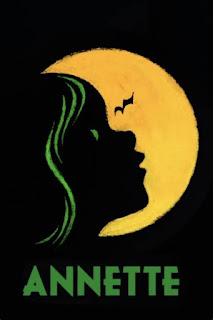
Annette


ANNETTE   **1/2

Leos Carax
2021


IDEA:  A stand-up comedian experiences a drastic decline in his career while he raises a preternaturally gifted baby girl with his opera singer wife. 


BLURB:  By what metric does one evaluate such a flagrantly proud farrago as Annette? Certainly no traditional critical schema is fit to accommodate the film’s defiant unruliness, its indiscriminate blending of opera, camp, metatextuality, and emotional sincerity. There is a gentle perversity about the film’s nearly unrelenting gaucheness, how Carax and the Mael brothers seem to approach each moment with the modus operandi of affective dissonance. They walk an extreme razor’s edge between irony and earnestness, sophomoric parody and artistic meditation, with the viewer never quite sure which mode they’re experiencing. Is Carax even sure? The film careens around with an abandon that can, at times, feel stubbornly random, as if its pell-mell construction alone could serve as an alibi against formal critique. All this being said, Annette is not as outré as one might have expected from its eccentric auteurs. Essentially a macabre arthouse rendition of A Star is Born, it trades in shopworn ideas about the trials of celebrity and the artist’s process, with a particular emphasis on the psyche of the disillusioned, self-loathing male creator. These are clichés Carax and the Maels simultaneously embrace and spoof; so too their conceits about parenting anxieties, which manifest in the film’s most memorable invention, the titular, sentient wooden puppet child. The individual elements here are familiar, but in Annette’s combination of them, they become deliberately wrong, uncanny, garish. The music, symphonically rousing and self-consciously stilted in the same breath, follows suit. To the extent that anyone possibly could, Carax pulls together this shaggy experiment in the denouement, a sobering duet that denudes the cover of creative expression to reveal its whimpering human soul. 

Monday, August 16, 2021

The Green Knight


THE GREEN KNIGHT   ***

David Lowery
2021


IDEA:  After agreeing to land a blow to the fearsome Green Knight, Gawain, the indolent nephew of King Arthur, must make a quest from the castle one year later to reciprocate the challenge.


BLURB:  More than many films based on Western folklore, The Green Knight has the air of something genuinely archaic and occult, like a cryptic relic from a long-extinct civilization. It’s in the film’s becalmed focus on gnomic rituals and encounters; its alternately tenebrous and ghostly images, in which computer-generated backdrops and expressionistic lighting lend a sense of the ethereal; and in its indeterminate temporality, with Lowery condensing hours, days, and years into a matter of minutes, a trick that connects back to his previous metaphysical fable, A Ghost Story. At the same time, the film constantly reminds us of its status as an adaptation, its literary intertitles positioning the story as a modern reimagining of a popular text. It’s somewhere in between these two modes - historical document and revisionist interpretation - where The Green Knight provocatively exists. Lowery already tips us off to the latter in his casting of the Indian-British Dev Patel in the role of Gawain; beyond this conspicuous ethnic alteration, the director also pointedly saps Arthurian England of its romantic grandeur, figuring it instead as an ashen, dilapidated graveyard dotted by fires. In this reframed context, Gawain’s quest to prove his chivalry and earn his veneration looks more like a hollow ego-driven pursuit than a testament of virtue. Throughout, Lowery draws out the faults in Gawain’s masculinity and the codes of honor he and the Court abide by, their stringent dictates exposed as essentially fruitless by the titular force of nature, rendered as a lumbering, immortal mass of tree bark and leaves. The Green Knight itself has a similarly plodding gait; despite its persistently entrancing atmosphere, the film could use a little more tonal variation to break up its overly stolid and studied demeanor. Still, it’s a haunting, sensorily rich spin on the Arthurian mythos that works as both a faithful adaptation and an astute reconsideration of its underlying concepts.

Wednesday, August 4, 2021

Easy Living


EASY LIVING   ***

Mitchell Leisen
1937


IDEA:  A downtrodden female typist is thrust into the world of the elite when she is mistaken for the mistress of a powerful banker.


BLURB:  Easy living is not exactly easy in Mitchell Leisen and Preston Sturges’ rambunctious screwball comedy. Already proving himself among the keenest social satirists in early Hollywood, Sturges wryly links the titular term with the vacuous existence afforded by wealth and status. It’s the life of Edward Arnold’s blustery, gormless banker J.B. Ball, and, by convoluted proxy, the life that gets unwittingly foisted upon Jean Arthur’s demure typist Mary Smith. The madcap daisy chain of misunderstandings, assumptions, and hearsay that results in Mary’s sudden prestige - and that threatens both Ball’s fortune and the market at large - is a sardonic sendup of gendered power relations under consumer capitalism, underscoring the degree to which the petty whims of influential people shape the economy and media culture. This toothy social commentary is pure Sturges, as is the knockabout slapstick that memorably erupts from the desperate hunger of diners at an automat. Leisen directs with a fleetness that serves Sturges’ hectic dialogue and tone well, while a coterie of distinguished character actors provide fizzy support to Arthur and Ray Milland’s sweetly fledgling romance. Meanwhile, art director Hans Dreier leaves nothing behind on the film’s most stunning set, a labyrinthine hotel penthouse that’s opulent and outrageous in all the right ways. Easy Living somewhat paints itself into a corner in its final third - after all the zaniness, Sturges doesn’t quite seem to know how to pull everything together - but the film still lands as a tart screwball delight.

Wednesday, July 21, 2021

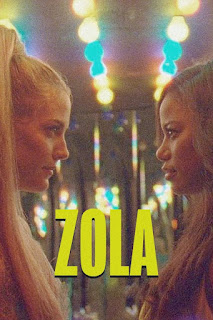
Zola


ZOLA   **1/2

Janicza Bravo
2020


IDEA:  Zola, who works as a stripper and waitress in Detroit, gets in over her head when she takes an impulsive road trip to Tampa with her new friend Stefani.


BLURB:  Increasingly, filmmakers have taken on the task of cinematically reproducing the visual idioms of social media, integrating into their films’ formal designs texting iconography and digital-style interfaces. It comes as something of a surprise that Zola, which has its genesis in a viral Twitter thread, is largely devoid of such devices. Outside of its soundtrack of dinging phones and the occasional diegetic screen, the film feels oddly detached from the medium through which its story was initially delivered. In effacing so much of the original mode of communication, the script by Bravo and Harris offers a fairly straightforward dramatization of events, emphasizing the escalating absurdity and danger of the circumstances in which Aziah “Zola” King finds herself over one nightmarish weekend. Bravo is less interested in how her perilous tale was consumed and shared in the online space than in how the events themselves illuminate the virulent realities of contemporary American racism, sexism, and economic exploitation. She is especially effective at sowing an atmosphere of clammy unease, making nocturnal Florida streets and homogenized chain hotels alike into sites of pronounced societal tension. This looming menace is more engaging than the characterizations, which feel overly attenuated despite the fiercely committed performances. What is perhaps most compelling is not anything in Zola itself, but what its very existence implies: a victimized woman taking control of the narrative with strength and irreverence, emerging as not only a storytelling sensation but a tenacious survivor.

Friday, July 16, 2021

Double Lover


DOUBLE LOVER   ***

François Ozon
2017


IDEA:  A troubled woman engages in a torrid romance with a therapist who happens to look exactly like her therapist husband.


BLURB:  An unapologetically overcooked pastiche of erotic thriller, loopy psychodrama, and Cronenberg-lite body horror, Double Lover is as intriguing as it is outlandish and unwieldy. What remains true is that Ozon knows how to establish and tease his concepts with flair; from his evocative labia-to-eye match cut to the profusion of mirrored imagery and temporal ellipses, he creates an unstable, ambiguous world of psychosexual neurosis, wherein bodily boundaries of inside and outside, self and other, fantasy and reality, become a blurred continuum. Here, the twin-double is a multivalent signifier of ego division, both a reflection and a refraction. Double Lover’s knotty logic is such that Chloé, through whose unreliable perspective the entire movie unfolds, fantasizes her own phantom twin as a more aggressive double of her male lover. Through the resulting gender-fluid triangle, she’s able to role-play as sadistic parent and masochistic child, working through both her fraught relationship with her estranged mother and the burden of her own unborn twin sister, physically and metaphorically lodged in her womb. The scenario is pure pulp psychoanalysis, its frequent risibility exacerbated by how Ozon plays it so literally in the context of Chloé’s therapy. If one can look past its heavy-handedness, as well as some of its gauche metaphysical explanations, Double Lover ends up functioning as an affecting allegory of repression, a visceral depiction of the process of identifying and expelling internalized grief. Ozon knows as well as anyone else that the cinema, the ultimate “double” in art, perfectly serves such primal drama.

Thursday, July 8, 2021

In the Heights


IN THE HEIGHTS   ***

John M. Chu
2021


IDEA:  In Manhattan's Washington Heights neighborhood, a range of characters negotiate cultural heritage, love, belonging, and dreams of personal and social progress.


BLURB:  There’s something to be said of a movie that manages to sustain a level of raucous energy for nearly two-and-a-half hours. Rather than exhaust or oppress, this milieu of buzzing commotion is part and parcel of the infectious celebratory spirit of In the Heights, which bursts with an exuberant love of Latin culture, diasporic identity, and the immigrant communities that comprise the bedrock of America. Chu’s adaptation of the Broadway musical shoots out of the gate from its opening number, a musique-concrète city symphony turned dancing-in-the-streets extravaganza, and from then on, pinwheels and ignites in an ingratiating riot of motion and sound. It might be easy to take issue with the fairly frictionless, anodyne nature of this party atmosphere if In the Heights wasn’t clearly designed to offer a vision of an urban immigrant utopia, an expression of ancestral cultural fecundity in which geographic distances are bridged and dreams are self-actualized. The story does not ignore sociopolitical struggle - gentrification, assimilation, and racism are all touched upon - but these are not the point, nor are they permitted to dampen the peppy mood for long. Sometimes, In the Heights is perhaps overly hectic, with Myron Kerstein’s breakneck editing too often splintering and obscuring the choreography in spatially chaotic flurries. It’s a testament to the film's winning performances, musical panache, and enormous heart that, by the end, such craft quibbles largely fade under the summery effulgence, as warm as the island sun in Manhattan.